

Exterior wall defects usually appear a few years after handover: hairline cracks across the render, swollen joints, water marks near the ground. As a board manufacturer we see the other side of this, the warranty claims and the customers who do not reorder. What strikes us is how many of these failures trace back to a material decision made before construction even started.
An exterior wall has to resist rain, absorb structural movement, and meet fire codes at the same time. This article explains why fiber cement board handles that combination well, and what buyers should check before ordering.
Why other boards struggle outside
Gypsum board is an interior product. Outdoors, water reaches the paper facing and the core, and the facing delaminates within a few wet seasons.
Timber panels depend on regular repainting. When maintenance slips, and on most projects it does, they absorb water, swell, and rot.
Steel cladding performs in weather but costs more per square meter, which is why it stays mostly on industrial buildings.
What makes fiber cement board different
The board is made from Portland cement, fine quartz sand, and natural cellulose fiber. Two manufacturing steps do most of the work. The mat is compressed under a minimum of 7,000 tons of pressure, then cured with high-temperature steam. That combination produces a dense, stable microstructure. The technology has an interesting history too: it was developed in Germany and has been running in Chinese factories for close to twenty years.
The test numbers explain the field behavior. Density runs 1.2 to 1.5 g/cm3, flexural strength is 16 MPa or above, and moisture expansion stays under 0.25%. Certified boards pass 25 freeze-thaw cycles with no cracking or delamination under GB/T7019-2014. The Chinese product standard for fiber cement flat board is JC/T412-2018, and buyers can request test reports against it.
Cracking
dense panels move very little with temperature change, so movement stays in the designed joints instead of crossing the wall surface. That is why facades on fiber cement board show fewer hairline cracks than rendered masonry.
Moisture
cement does not rot and does not support mold. Our outdoor boards are rated at 30% water absorption or below, and the freeze-thaw results above matter most in cold climates, where lighter boards spall after a few winters.
Fire
the boards reach Class A non-combustible under GB 8624, with a fire resistance limit of 240 minutes tested to GB/T9978-2008. After the high-rise facade fires of recent years, more countries test cladding for combustibility, and cement-based boards are taking specifications that once went to sandwich panels.
What buyers should check before ordering
Which fiber is inside? This is the question many buyers forget to ask. Some fiber cement boards on the Chinese market still use chrysotile fiber, which the EU, Australia and a growing list of markets restrict. Asbestos-free boards use plant-based cellulose fiber instead. Ask for written confirmation, and a third-party test report where customs requires one.
Does the report cite a standard? A test report with no standard number on it is close to worthless. Look for JC/T412-2018 or an equivalent national standard, and check the date, since reports get recycled.
Density and thickness matched to the application. For LOFT and steel mezzanine floor slabs, 2400 x 1200 mm boards at 18 to 30 mm are the working range, and 24 mm is the thickness most projects settle on. Exterior wall panels run 12 to 30 mm. Ceilings start at 6 mm.
Sizes against your fixing system. Common formats are 1220 x 2440 mm and 1200 x 2400 mm. Outdoor boards also come in 3000 x 1220 mm, and small formats like 1200 x 600 mm and 600 x 600 mm. Confirm the format fits your local fixing system before booking the container.
About Danae
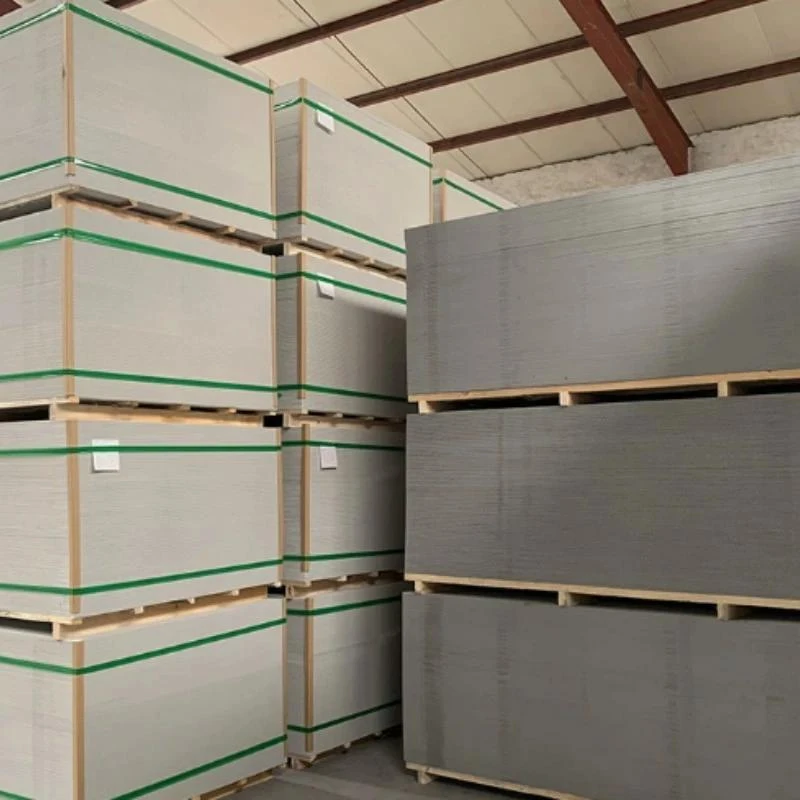
Our fiber cement board factory is in Tangshan and has run for seven years. Two automated lines produce 5 million square meters a year, and a separate interior wall panel capacity adds 8 million square meters.The range covers asbestos-free boards, high density exterior and floor panels, pre-coated inorganic boards, and ceiling boards, 6 to 30 mm thick, with custom sizes, finishes, and designs. Pre-coated boards ship regularly to the Bahamas, Canada, and New Zealand, and our main markets are Southeast Asia, Russia, the Middle East, Africa, Central Asia, and India. Standard lead time is 7 to 10 days, and high density floor boards ship with fire test reports. Samples go out before any order commitment.
Full specifications for each board type are on the fiber cement board products page.
One last point
Sample testing is usually the first thing buyers cut when delivery dates get tight, and it is the check that catches most of the problems in this article. Two weeks of exposure testing costs one pallet of samples. When you compare quotes, compare the test reports next to them: two boards at the same price with different fiber content and different standards behind them are not the same product. If you have a project specification ready, our team can advise on grade, thickness, and coating, and arrange samples.