I. Brand and Category Differences
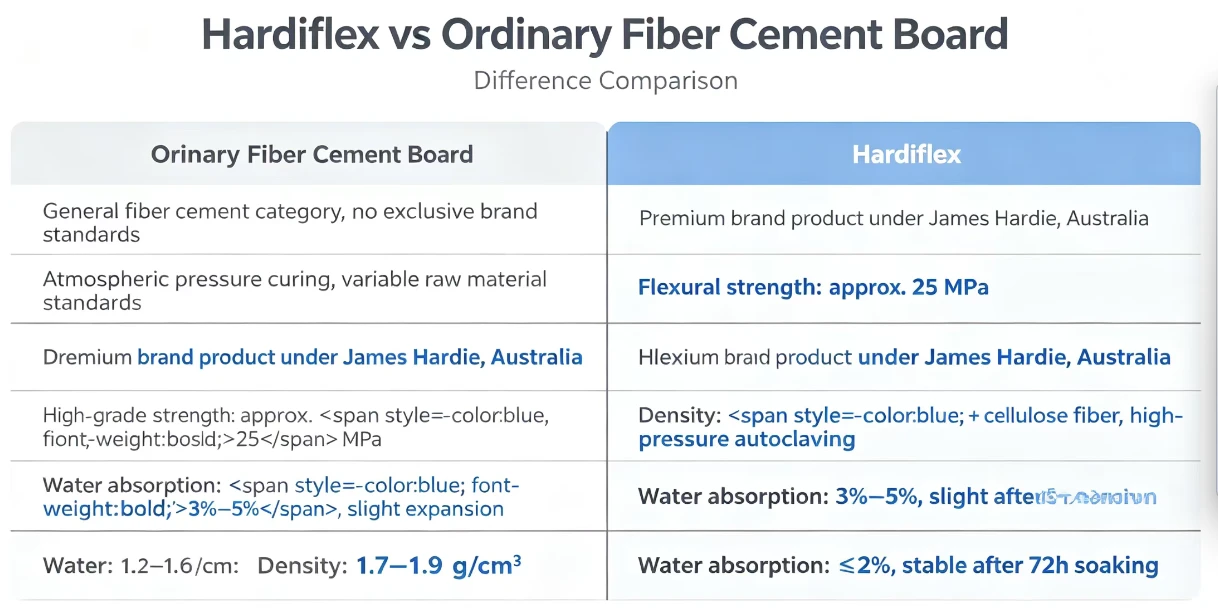
* **Fiber cement board:** A generic category name referring to all construction boards made primarily from cement and fibers; it is not tied to a specific brand, and various manufacturers produce such products.
* **Hardiflex:** A proprietary product from the Australian company James Hardie; it represents a specific high-end product line within the fiber cement board category, and the name is exclusive to this brand.
II. Raw Material and Manufacturing Process Differences
* **Standard Fiber Cement Board:** Most utilize standard atmospheric curing processes; raw material ratios lack strict, unified standards; some low-cost products may incorporate recycled fibers; density varies widely, typically ranging from 1.2 to 1.6 g/cm³.
* **Hardiflex:** Uses high-grade Portland cement as the primary binder combined with a proprietary blend of high-quality cellulose fibers; manufactured using a brand-specific high-pressure steam curing process; the finished product maintains a stable density of 1.7–1.9 g/cm³ and features a denser internal crystalline structure.
III. Performance Parameter Differences
* **Flexural Strength:** Standard fiber cement boards have a flexural strength of approximately 25 MPa, whereas Hardiflex exceeds 35 MPa; its impact resistance is 1.4 times that of standard products.
* **Water Resistance:** Standard fiber cement boards have a water absorption rate of about 3–5% and are prone to slight swelling after prolonged immersion; Hardiflex has a water absorption rate of ≤2% and shows negligible dimensional change after 72 hours of immersion, making it suitable for environments with long-term exposure to moisture.
* **Service Life:** Standard fiber cement boards have an outdoor service life of approximately 15–20 years; Hardiflex undergoes special weather-resistance treatment, extending its outdoor service life to over 25 years, with superior freeze-thaw and acid-alkali resistance.
IV. Product Specifications and Application Scenarios
* **Standard Fiber Cement Board:** Standard thicknesses range from 6 to 24 mm, typically available in universal sizes; primarily used for basic decoration, standard partition walls, and other applications with less demanding requirements. Hardiflex: Offers a highly segmented product line ranging from 3.5mm ultra-thin to 12mm extra-thick boards, suitable for applications such as exterior cladding, ceilings, bathroom wall panels, and outdoor curtain walls; certain specialized variants can even serve directly as structural backing boards.
V. Price and Compliance Differences
Standard Fiber Cement Board: Market prices vary widely; products of the same dimensions cost only 50%–70% of Hardiflex's price, and products from some smaller manufacturers may lack asbestos-free certification.
Hardiflex: Commands a higher price point-taking the Philippine market as an example, a standard 6mm board sells for approximately 937 pesos. The entire product range is explicitly labeled as asbestos-free and complies with international Class A environmental standards for building materials.