

A shift we did not see coming two years ago
When we started running the fiber cement board lines back in 2019, most of our export orders were straightforward: a container of 1200×2400mm boards, standard thickness, shipped to a distributor who would resell them. Prefab and modular builders were a small slice of the business. That has changed. Over the past 18 months, we have seen a steady rise in inquiries from buyers who are not buying for a warehouse-they are buying for a wall section that has to be assembled in a factory, moved by truck or rail, and lifted into place on site. This is a different kind of customer, and it has forced us to rethink something basic: how we hold stock.
Why standard stock no longer fits every order
The old model was simple. We kept a deep stock of common thicknesses-mostly the mid-range used for interior partitions-and when an order came in, we cut, packed, and shipped. For a distributor, that worked. For a prefab buyer, it often did not.
Their wall modules are built to a fixed drawing. If the drawing calls for a thickness that sits at the edge of our standard range, or a panel size that cuts down on waste, a container of standard boards creates a problem at their factory rather than solving one. We heard this repeatedly from buyers in the Middle East and Central Asia: the lead time was fine, the price was fine, but the standard board required extra cutting on their line. That generates dust, wastes material, and eats up labor hours. In a prefab yard, wasted labor holds up the whole module sequence.
We are adjusting our stock plan to hold more of the sizes and thicknesses that prefab buyers actually ask for. This is not a marketing promise-it is a change in how we schedule the lines. Our annual capacity sits at 8 million square meters, and the production base covers 50,000 square meters, which gives us room to hold a wider range without starving the standard orders.
We are also making the batch traceability process tighter. When a buyer requests a specific thickness and finish for a multi-shipment project, we want to confirm the same production batch is available to avoid color or density variations between modules.
In addition, our sales team is now required to confirm packaging details at the quotation stage, not after the order is confirmed. If a buyer needs wooden pallets and waterproof wrapping for a rail shipment to a landlocked site, that needs to be in the FOB price from the start, not added as a surprise later. For buyers who want to see the product specs before a conversation, the fiber cement board interior page carries our current thickness range and standard sizes.
What this means for buyers planning their next order
If you are sourcing for a prefab or modular project, the practical takeaway is to tell us the actual wall build-up, not just the panel size. The thickness that works for a dry office partition is not the same as the one that works for a wet area or a corridor wall that takes impact.
When we know the build-up, we can check whether the requested range is in regular stock or needs to be scheduled. The 7–10 working day window we quote after deposit holds for our regular stock items. For the newly added prefab-friendly sizes, we are building up inventory, but it is always worth confirming availability before you plan the module sequence. If the drawing requires a totally custom specification, we will tell you the realistic production lead time upfront. That conversation costs a few emails. Skipping it costs more at the factory.
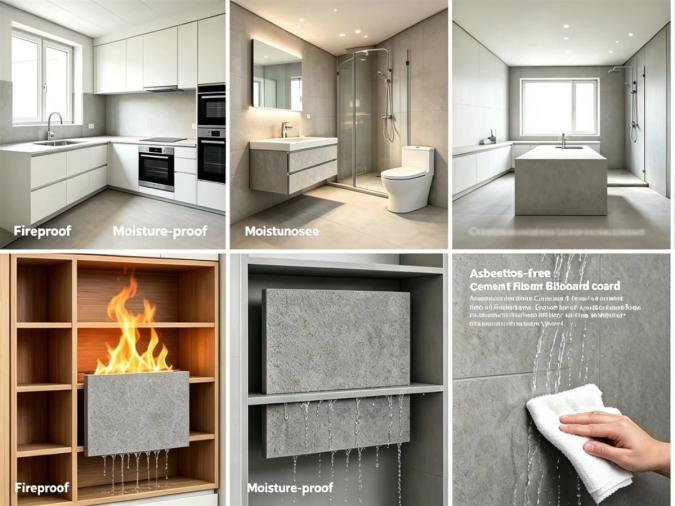
Prefab buyers are also asking harder questions about documentation, and we welcome it. More inquiries now include a request for the fire test report with the testing standard and lab name, not just a line on a data sheet. Some buyers ask for the formaldehyde or VOC declaration before they will approve the board for an occupied interior.
We have started including these documents in the initial quotation package for prefab projects, so the approval process does not stall while paperwork goes back and forth. If you are comparing suppliers, ask for the report that names the standard-EN 13501-1, ASTM E84, or the local code your project falls under.
A supplier who can produce that before the order is easier to work with than one who promises it after.
Where we go from here
We are not claiming this solves every prefab sourcing problem. What we are doing is listening to the buyers who have told us where the friction is, and adjusting our stock and documentation process around it. If you are planning a modular or prefab interior project and want to check whether your required thickness and finish are in stock, send us the wall build-up details and we will tell you what is realistic. That is a more useful starting point than a price list.
Our export team sits right next to the production floor, so when you send over a tricky wall drawing, we can walk out and check the actual boards with the line manager before replying.