

Key Properties & Advantages of Fiber Cement Board:
Unmatched Durability & Longevity: Fiber cement board is highly resistant to rot, termites, decay, and impact damage. It withstands harsh weather conditions, including UV radiation, heavy rain, freeze-thaw cycles, and strong winds, without warping, cracking, or delaminating. This translates to significantly lower maintenance costs and a much longer lifespan compared to many alternatives.
Superior Fire Resistance: Being primarily composed of mineral-based materials (cement and sand), fiber cement board is inherently non-combustible. It achieves excellent fire ratings (often Class A), acting as a significant barrier to flame spread, making it a crucial safety component in both residential and commercial construction.
Moisture & Weather Resistance: Fiber cement board exhibits outstanding resistance to moisture absorption and damage. It does not swell, warp, or promote mold growth when properly installed, making it ideal for high-humidity areas, exterior cladding (siding), roofing underlayment, soffits, and wet interiors like bathrooms.
Dimensional Stability: Unlike wood, which expands and contracts significantly with moisture and temperature changes, fiber cement board remains remarkably stable. This minimizes issues like cracking joints or gaps in finished surfaces over time.
Versatility in Design & Application: Fiber cement board is incredibly versatile. Available in various profiles (siding planks, shingles, flat sheets), thicknesses, textures (smooth, wood-grain, stucco), and colors (pre-finished or paintable), it suits numerous applications:
Exterior: Siding (cladding), soffits, fascia, trim, decorative accents.
Interior: Wall and ceiling linings, tile backer board (especially in wet areas), fire-rated assemblies, partitions, flooring underlayment.
Specialized: Substrate for thin brick/stone veneers, signage boards.
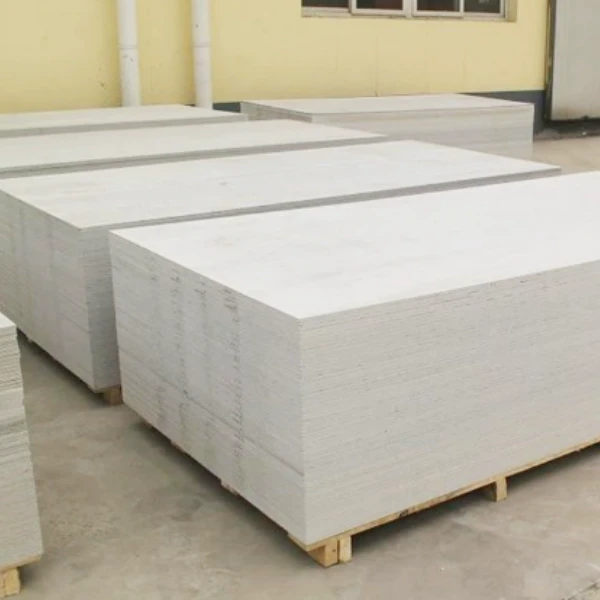
Sustainability: Modern fiber cement board is typically manufactured without asbestos (a historical concern phased out decades ago). It often incorporates recycled materials (fly ash, slag) and is itself durable and long-lasting, reducing the need for replacement. Many products are recyclable at end-of-life.
Manufacturing Process (Hatschek Method):
The predominant method for producing fiber cement board is the Hatschek process:
A slurry of cement, sand, cellulose fibers, and water is created.
This slurry is deposited onto a moving felt mesh, where water is vacuum-extracted, forming thin layers.
Multiple layers are continuously built up on a rotating cylinder to achieve the desired thickness.
The continuous sheet is cut into boards.
Boards undergo high-pressure steam curing (autoclaving) to achieve full strength and stability.
Boards may then be textured, pre-primed, pre-painted, or left unfinished.
Why Choose Fiber Cement Board?
Long-Term Investment: Lower lifetime cost due to minimal maintenance and replacement needs.
Enhanced Safety: Superior fire resistance protects structures and occupants.
Design Freedom: Wide range of aesthetic options to achieve desired looks.
Performance Reliability: Proven performance in demanding environments.
Building Code Compliance: Meets stringent requirements for fire, moisture, and impact resistance.
Conclusion
Fiber cement board stands as a premier building material, offering an exceptional blend of strength, resilience, safety, and aesthetic flexibility. Its resistance to fire, moisture, rot, pests, and weather extremes makes it a smart, long-lasting choice for demanding exterior cladding, reliable tile backing, robust interior linings, and critical fire-rated assemblies. When durability, safety, and low maintenance are paramount, fiber cement board consistently delivers superior performance, solidifying its essential role in modern construction.