

A perforated gypsum board may look simple once it is installed. On the production floor, however, getting a large board covered with a clean, even hole pattern is not quite as simple.
The position of each hole matters. The spacing needs to stay consistent, and the board has to move through the punching process without unnecessary movement. These details become especially noticeable when the finished panels are used across a large ceiling or wall.
That is one reason perforated gypsum board has become a practical option for some interior acoustic applications. It can provide a finished gypsum surface while working as part of a wall or ceiling construction designed to manage sound.
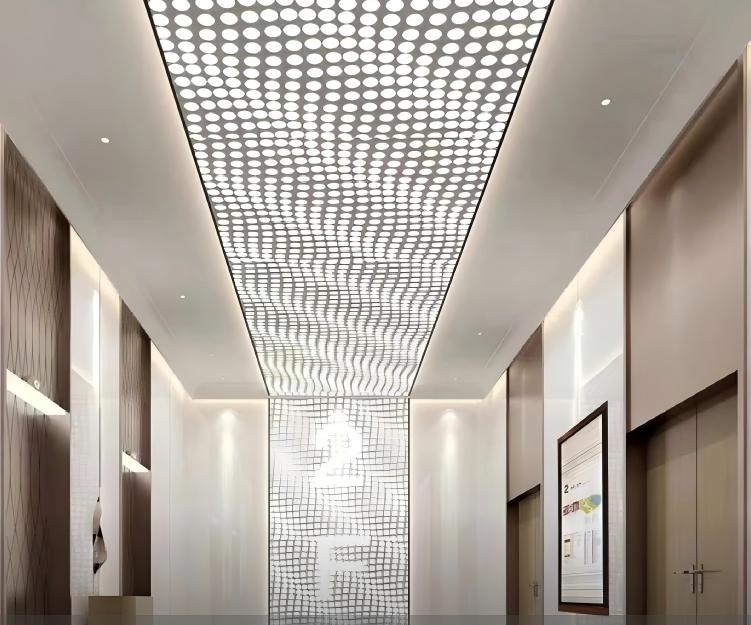
Why Are Gypsum Boards Perforated?
A regular gypsum board gives an interior surface a flat and uniform appearance. A perforated board introduces a different surface structure, with openings arranged in a specific pattern across the panel.
These openings can allow the board to work with acoustic material and the cavity behind it. The result depends on the complete construction rather than the board alone. Hole size and spacing, the board structure, backing material, cavity depth, and installation method can all affect the finished acoustic performance.
This makes perforated panels useful for projects where the appearance of the ceiling or wall still matters alongside acoustic treatment. Offices, conference rooms, cinemas, auditoriums and hotels are some examples where this type of interior panel may be considered.
The production side has its own requirements. When a repeated pattern covers a 1.2 m or larger panel, a small positioning error is much easier to see than it would be on a small component. A panel can therefore meet the basic material specification and still need further attention if the perforation pattern is not consistent.
The Production Challenge Is Keeping the Pattern Consistent
The punching process itself is straightforward: the board is fed into position, the selected pattern is punched, and the processed board moves on.
The difficult part is repeating the same movement accurately across many boards.
Board dimensions and thickness are the first things to define. The machine needs to handle the actual range of boards being produced, while the feeding system needs to keep the panel in the correct position during punching.
The hole pattern comes next. Round and square holes are common choices, but manufacturers may also produce panels with different arrangements for specific architectural projects. That means the mold is not just a machine accessory; it is part of the finished panel design.
Feeding accuracy also deserves attention. If the board shifts slightly before or during punching, the spacing between holes can change. On a decorative acoustic panel, this may be visible after installation.
For this reason, automatic feeding and positioning can be useful when the same perforation pattern needs to be repeated over a production run. It reduces reliance on manual positioning and gives the operator a more consistent working sequence.
From Board Design to Punching Equipment
Equipment selection makes more sense once the finished panel has been defined.
A manufacturer may start with a particular board size and thickness, then decide on the hole shape, spacing, production volume and mold configuration. These details determine what kind of punching setup is practical.
A gypsum board punching machine is used to carry out the main perforation process. Depending on the configuration, the system can combine automatic feeding, positioning, PLC control and interchangeable tooling for different board designs.
View Gypsum Board Punching Machine
For example, Danae's gypsum board punching machine is designed for board processing up to 1220 × 2440 mm, with a maximum feeding thickness of 15 mm. The equipment uses PLC and touch-screen control and supports automatic positioning and feeding. These specifications are useful when checking whether the machine fits a particular board production plan, but they should be considered alongside the required mold and finished panel design.
Think About the Finished Panel First
For a company adding perforated gypsum board to its product range, starting with the machine is not always the most useful approach.
It is better to define the product first. What board sizes will be produced? What thickness range is required? Which perforation patterns are needed? How many boards need to be processed in a normal production period? Will one mold be enough, or will several panel designs be offered?
Once these questions are clear, the punching equipment and tooling can be matched to the production process.
This is also worth considering when planning for future products. A manufacturer may initially produce one perforated ceiling panel and later introduce another pattern or board specification. A production setup that can accommodate reasonable changes can be more practical than one designed around a single finished product.
For building material manufacturers, the value of a punching system is therefore not simply how many holes it can make. The more useful question is whether it can repeatedly produce the board pattern, size and finish that the final project requires.
Perforated gypsum board sits at the intersection of material design, interior application and manufacturing. When those three parts are considered together, it becomes easier to choose the right production method and avoid treating the punching machine as an isolated piece of equipment.