


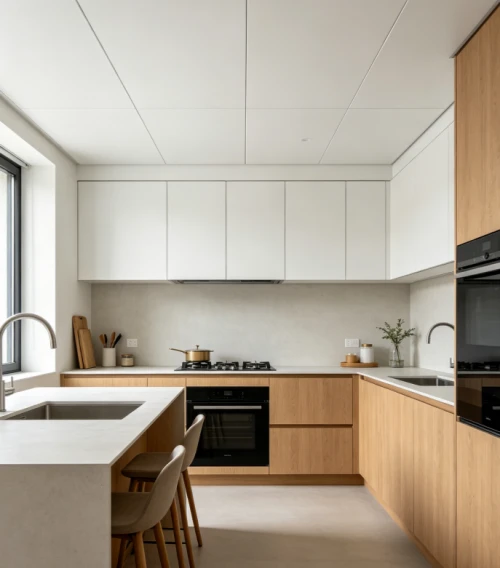
Fiber cement board works well for ceilings, especially where fire and moisture resistance matter-think kitchens, bathrooms, basements, and commercial spaces. For dry living rooms or bedrooms, though, you'll want to weigh its weight against how much you care about design flexibility.
Key advantages
Fire and moisture resistant – Meets Class A non‑combustible standards and holds up in humid conditions without warping or sagging. A solid choice for wet areas.
Tough and low‑maintenance – Resists rot, corrosion, and pests. It gets stronger over time and rarely needs attention after installation.
Decent sound and thermal insulation – At moderate densities it provides good acoustic and thermal performance. Perforated versions work well as sound‑absorbing ceilings.
Limitations to keep in mind
Heavy – Weighs more than gypsum board or aluminum panels. You'll need two people to handle it, and the ceiling grid must be strong enough to support the load.
Tricky to install – The material is brittle and chips easily during cutting. Cutting also creates a lot of dust and requires specialised tools. Joints can crack if not finished properly-better to hire a pro.
Limited shaping – Flat surfaces are fine, but curves or complex forms are difficult. It's less decorative than plasterboard, and you usually have to paint it to get a finished look.
Choose the right type – Go for low‑ to medium‑density boards (0.9–1.5 g/cm³) with a thickness of 4–6 mm. High‑density boards are more prone to deformation.
Where to use it
Highly recommended – Kitchens, bathrooms, balconies, basements, shopping centres, hotels-anywhere moisture or fire ratings are a concern.
Use with caution – In dry living rooms or bedrooms, if you want something lightweight or need intricate shapes, gypsum board might be a simpler alternative.
When buying, make sure the product is labelled "asbestos‑free." During installation, leave expansion joints and seal the seams properly against moisture.