


1. Their "Genes" Are Different from the Start
You can think of these two types of boards as two brothers with very different personalities.
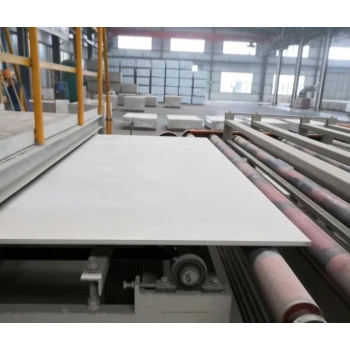
Calcium silicate board is like the "gentleman" in the family. Its main raw materials are siliceous and calcareous materials, combined with reinforcing fibers, and it is produced through a "sauna-like" autoclaving process. As a result, its core identity is "calcium silicate hydrate." This determines its characteristics: it is lighter, softer, and more "delicate." Its strength lies in its stability, making it particularly well-suited for "gentle" environments, such as dry indoor ceilings and partitions.
Fiber cement board, on the other hand, is the "tough guy" in the family. It contains a higher proportion of cement and high-strength siliceous materials in its composition. Although it also undergoes an autoclaving process, the final product has a higher density and is more "robust." Its core identity is a "high-density cement-based product." As a result, its characteristics include hardness, impact resistance, and excellent weather resistance. It is naturally designed to withstand wind, rain, snow, and various physical impacts.
2. More Than Just Density: The Responsibility That Comes with It
Many people know that fiber cement boards are heavier than calcium silicate boards. However, what we should focus on is not the number itself, but the responsibility that comes with that "heaviness."
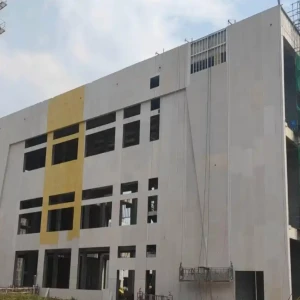
If you are constructing exterior walls-especially in areas prone to typhoons and hailstorms, or where buildings experience drastic temperature changes-the "tough guy," fiber cement board, is a more reliable choice. Its high density and strength better resist impacts and allow it to maintain a longer lifespan under freeze-thaw cycles. It is like putting a strong layer of armor on a building.
Calcium silicate board is a much more forgiving product to work with and can be processed with standard woodworking tools for easy installation, regardless of the configuration. Its relatively lower bulk density results in a higher degree of porosity, resulting in greater water absorption and a greater chance of cumulative damage due to freeze/thaw cycles when exposed to an outdoor environment vs. fibre cement board. As such, calcium silicate board will typically behave more like a fairly fragile inner face layer where you would desire to exhibit its smooth surface texture and stability within an enclosed setting.
3. The Secret Behind the Price: Hidden Where You Can't See
Speaking of price, it is true that fiber cement boards are usually more expensive than comparable calcium silicate boards. However, we should not focus solely on the "purchase price"; we need to consider the "lifecycle cost."
Have you ever wondered why they are more expensive? It is because achieving superior weather resistance requires higher pressure during production, greater energy consumption, and more advanced formulations. Every extra dollar spent buys peace of mind for the next ten years or even decades, reducing the need for replacement and repairs.
On the other hand, some extremely cheap calcium silicate boards may have reduced reinforcing fiber content or insufficient curing time. While they may save money in the short term, if they begin to powder or warp after a few years, the labor cost of replacement will far exceed the initial savings on the material.
Therefore, my advice is: don't get stuck on the question of "which is better," because there is no absolute "better"-only what is more suitable for your specific project.
For projects that include the exterior wall surfaces of a high-rise building, wet locations requiring tile or stone finishes (such as kitchens and bathrooms), or industrial structures that need to be built to withstand wear, fiber cement board is an ideal choice because of its strong performance and ability to provide you with peace of mind.
Calcium silicate board can be used to complete projects that call for ceiling installations (in dry indoor environments), partition walls with a high degree of flatness, or for temporary structures, because it is inexpensive to use due to its lightweight design and ease in processing as well as being capable of providing you with sufficient structural support.