


1. Structural Support and Strength Deficiencies: Joints Have No Place to Attach
This is the most fundamental and critical reason. The framework of a light steel or wooden stud partition wall consists of a top track, a bottom track, and vertical studs spaced at regular intervals (usually 400 mm or 600 mm).
Standard horizontal installation: When gypsum board is installed horizontally, the joints on its short side (1.2 m wide) fall exactly on the centerline of the vertical studs. The long side of the board spans across several vertical studs. This allows all four edges of each gypsum board to be securely fastened to studs with self-tapping screws, creating a cohesive and highly stable wall base. All joints are supported by solid studs, providing a reliable foundation for subsequent joint treatment.
Incorrect vertical installation: When installed vertically, the long side of the board (2.4 m) runs parallel to the vertical studs. This prevents both long edges of the board from being fully secured to studs, forcing them to rely on a small number of screws in the middle of the board to connect to a few studs. More importantly, the vertical joints between the panels (the joints formed along the long edges) are hollow, unsupported by any studs. These joints are held together only by joint compound and tape, making them extremely weak. They are almost certain to crack under external impact, slight wall vibration, or temperature and humidity fluctuations. Such cracks can be long, conspicuous, and difficult to repair.
2. Joint Treatment and Cracking Risk: A Fatal Weakness in Workmanship
The final quality of a plasterboard wall depends largely on the success of joint treatment. Vertical installation significantly increases the difficulty and failure rate of this process.
"Floating" joints: As mentioned above, vertical joints lack stud support, like a bridge without piers. Even if they are filled with joint compound and reinforced with paper tape, these joints remain extremely fragile. Any slight deformation or settlement of the wall concentrates stress on this weakest point, causing cracks to appear.
Excessive joints: If a 2.8-meter-high wall is installed horizontally using 2.4-meter-long boards, only one joint is required along the height (joining a 2.4 m and a 0.4 m board). However, if installed vertically, each 1.2-meter-wide board creates a vertical joint running from top to bottom. A 4-meter-wide wall would therefore have three vertical crack-prone joints, each up to 2.8 m long, greatly increasing the likelihood of cracking.

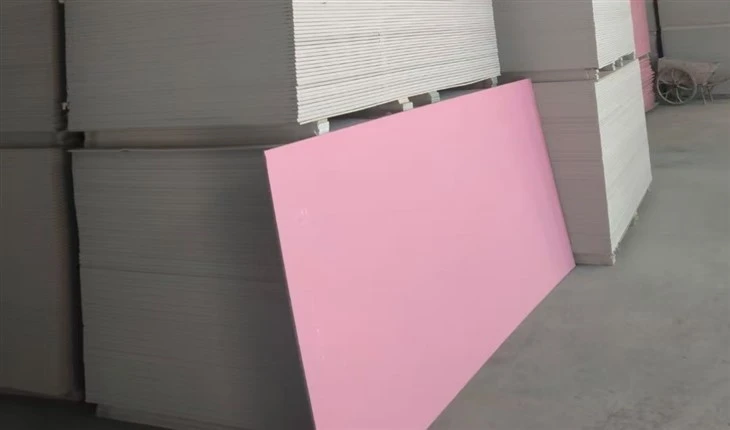
3. Material Properties and Waste
Adapting to board properties: The long edges of gypsum boards are factory-tapered or reinforced, providing greater strength and making them more suitable for bridging the gaps between studs. Horizontal installation fully utilizes this strength. Vertical installation, on the other hand, relies on the shorter, unreinforced edges to span between studs, making them more susceptible to deformation or breakage.
Material waste: Standard floor heights are around 2.7-2.8. Common gypsum board lengths are also 2.4 m or 3 m. Horizontal installation with 2.4-meter boards only requires one joint at the top or bottom, which maximizes material use and minimizes waste. Vertical installation requires more cutting, resulting in additional scrap and unnecessary waste.
4. Inefficient Construction
Horizontal installation allows workers to install large, full-length panels quickly, improving efficiency. Vertical installation requires handling more panels and creating longer joints, which increases both screw-fixing and joint-finishing work, making the process more time-consuming and labor-intensive.

Exceptions
You are not expected to deal with this particular case vertically unless the spacing between vertical studs in the partition wall is very small (e. g. 300 mm or 200 mm ) with adequate stud support for the long-side joints. However, this requires additional studs and rest, which adversely inflates material and labor costs. Consequently, such longitudinal builds are inefficient economically in a large num. Of standard projects, and Consequently hardly executed.