

What a gypsum board wrapping machine does
A gypsum board wrapping machine wraps stacked boards in stretch film before storage or shipment. It replaces hand wrapping with a machine-controlled film carriage, so film tension stays consistent across the whole stack and across every shift. The result is a tighter, more uniform package that resists edge damage, moisture, and stack shifting during transport.
A product that passes in-factory inspection can still arrive at the site with chipped edges, moisture deformation, or loose stacks. The choice of a gypsum board wrapping machine is often tested only after the boards leave the factory. Many gypsum board producers invest heavily at the end of the line to control flatness and moisture content, yet still rely on manual film wrapping or simple covers for the stacked boards. For exporters serving overseas markets, long sea freight and repeated handling amplify any weakness in the packaging step.
Where manual wrapping falls short for gypsum board
Gypsum board is a large-format, fragile, moisture-sensitive panel product. When workers wrap stacks by hand, film tension is hard to keep consistent: too loose and the film layers slip during transport, shifting the boards; too tight and stress concentrates at the edges, damaging the paper surface. Manual wrapping also depends on operator skill and stamina, so it easily becomes a bottleneck at the end of the line during peak shipping periods. A less obvious issue is seal consistency. Manual wrapping leaves gaps that let humidity fluctuations inside a sea container reach the boards, reducing strength after moisture absorption.
For these scenarios, the automatic gypsum board wrapping equipment does not simply mechanize what workers already do by hand. It turns film tension from a matter of operator feel into a machine-set parameter, and rebuilds the wrapping step around seal integrity and run continuity.
Some automatic wrapping systems use horizontal wrapping structures paired with pre-stretch film carriages. The pre-stretch carriage keeps film tension relatively uniform during operation, so the whole stack stays intact during transport. These machines typically support automatic film feeding, film-break detection, and low-film alarms, reducing unplanned downtime caused by running out of consumables.
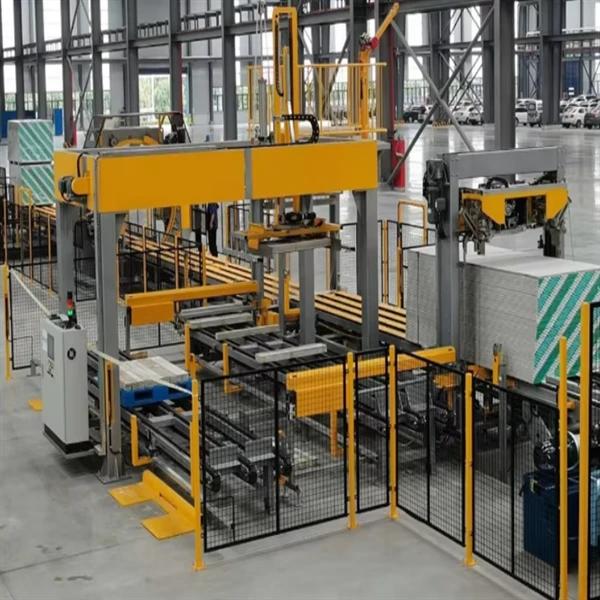
View Gypsum Board Wrapping Machine
What the specifications mean in practice
The palletized configuration positions boards on pallets with ±1mm precision, and the wrapping unit handles film heights up to 150mm at a packing rate of 25–35 cycles per minute. Power draw is 1.35kW or 12.5kW depending on configuration, and the machine weighs roughly 250–300kg. These are the figures Danae engineers work from when matching a unit to an existing line: film height determines the maximum stack profile, and the packing rate sets whether one wrapper can keep pace with the forming line. Units have been shipped to Southeast Asia, Russia, the Middle East, Africa, and Central Asia, where port handling and inland transfer add to the demands on package integrity.
For customers shipping on pallets, the palletized automatic wrapping system can work with a robotic arm to load and position boards automatically, with wrapping modes switchable between spiral, roping, and other preset programs. That means one machine can handle gypsum board products of different specifications and stacking patterns, instead of configuring a separate packaging solution for every stack type.
How packaging investment affects total cost
Procurement teams tend to treat packaging equipment as auxiliary cost, but its impact on total cost shows up in two easily overlooked places.
Transport damage
Inadequate packaging directly erodes order margins. For export orders in particular, the logistics cost of replacement shipments far exceeds the film consumed.
Labor stability
Staffing in packaging roles is a widespread challenge in manufacturing. The training cycle and the quality variation caused by turnover indirectly push up quality control costs.
Once running normally, and provided the film roll specification and pre-stretch ratio are set correctly, an automatic wrapping machine has room to reduce film consumption per stack compared with manual operation, and packaging consistency no longer depends on individual worker habits.
Buyers comparing options will find that Danae's gypsum board packaging equipment can be configured to match customer product dimensions and production tempo, covering everything from semi-automatic linear structures to fully automatic six-sided wrapping systems. For factories introducing automated packaging for the first time, it is practical to start with the interface to the existing production line and gradually verify machine performance under actual product specifications.
Practical factors to check when selecting a machine
When evaluating a gypsum board wrapping machine, beyond wrapping speed and automation level, it is worth including these three points in the assessment: film compatibility - stretch film of different thicknesses is handled differently by pre-stretch mechanisms, so confirm the machine supports the target film roll specifications; interface with upstream and downstream processes - whether the wrapper is a standalone station or embedded in a conveyor line directly affects floor layout and staffing; recovery logic after a fault - whether the machine stops automatically and gives an alert when film breaks or runs out determines whether one operator can oversee multiple machines per shift.