

Fiber cement board is revolutionizing the look, design and longevity of buildings across the globe. As a novel material in architectural design, it not just express its aesthetics but also represents durability and sustainability.
More Than Just the Surface: Comprehensive Performance Enhancement
Traditional building skin materials often require compromises between aesthetics and functionality. Fiber cement board fundamentally changes this dynamic. The main ingredients, which include cement, cellulose fibers, and mineral fillers, are processed under specific pressure and temperature conditions, resulting in a composite material that exhibits both great toughness and unmatched strength. In fact, its impact strength can be over 3 times that of standard concrete slabs. Further, it is relatively lightweight, at 15–20 kg per square meter.
This material is especially UV-stable.No matter whether in freezing north European cold, Middle East heat or high moisture coastal conditions, fiber cements boards remain perfectly stable. Its CTE (coefficient of thermal expansion) is only 1.5x10⁻⁶/°C, one way in which the temperature deformation problems are kept to a minimum. In other words, longer maintenance cycles and lower life-cycle costs.

Aesthetic Possibilities: From Simplicity to Complexity
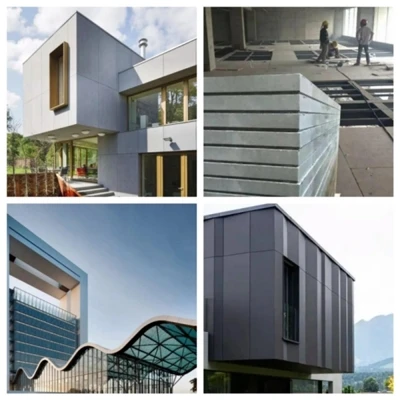
Current architectural trends promote an enhanced emphasis on design freedom, creating unparalleled opportunities using fibre cement board materials. The evolution of the coatings and treatment techniques for these products has allowed manufacturers to develop finishes that accurately match the characteristics of various natural materials including; hardwoods, stone and metals.
Architects are also exploring the formal possibilities of this material. Through CNC cutting and thermoforming technologies, fiber cement boards can be processed into complex three-dimensional curved surfaces.

Sustainability: A Future-Oriented Choice
Amid the global construction industry's pursuit of reduced carbon footprints, fiber cement boards offer a competitive solution. CO₂ emissions during the production process are approximately 40% lower than those of traditional aluminum panels, and the product itself is over 90% recyclable. A European study found that using fiber cement boards as building skins can reduce overall building energy consumption by 15–20%, thanks to their excellent thermal performance.
This material also supports modular building systems. In a high-rise residential development in Singapore, pre-fabricated fiber cement board cassettes were quickly erected on site, cutting construction time by 30% and waste production by 75%. This efficient way of building is especially ideal for redevelopment projects and emergency housing.
Installation and Maintenance: Advantages in Practice
The practicality of fiber cement boards is equally compelling for builders and owners. This means that with the 1220 × 2440 mm standard board size even using various board thicknesses (4–20 mm) a high degree of flexibility is available for design. The installation systems are widely used and available for covered fixing or open-joint systems to meet structural demand of different buildings.
Extremely low maintenance requirements are another key advantage. Advanced surface treatment technologies provide the boards with excellent stain resistance and self-cleaning capabilities. On the exterior wall of an office building in Milan that has been in use for 15 years, fiber cement boards have retained over 95% of their original appearance after only two basic cleanings. This durability directly translates into quantifiable economic value.
