


Differences in Characteristics between Cement Fiber Ceilings and Ordinary Ceilings
Cement fiber ceilings and ordinary ceilings (taking gypsum board as an example) differ significantly in performance, as shown in the following comparison:
1. Fire Resistance
Calcium silicate board: Meets A1 fire-retardant standards, non-combustible in high-temperature environments, does not release harmful smoke, and has a fire resistance rating exceeding 2 hours.
Ordinary gypsum board: Ordinary gypsum board has poor fire resistance and requires the addition of fiberglass or a moisture-resistant coating to achieve the same fire-retardant rating.
2. Leakage Resistance
Calcium silicate board: Remains stable under high humidity conditions (such as in shower rooms), without deformation or expansion, suitable for long-term damp and cold areas.
Ordinary gypsum board: Ordinary models tend to soften when exposed to water; water-resistant gypsum board (with a waterproof coating) should be used to improve moisture resistance.
3. Strength and Durability
Calcium silicate board: A 6mm thick board has a compressive strength exceeding that of a 9.5mm thick paper-faced gypsum board. It is more impact-resistant and crack-resistant, with a service life of 30 years or more.
Regular paper-faced gypsum board: Its strength decreases after being exposed to moisture, and long-term use may lead to cracking or deformation at the joints.
4. Sound and Heat Insulation Properties
fiber cement board ceiling : A 10mm thick partition wall provides better heat insulation than ordinary walls and better sound insulation than paper-faced gypsum board.
Regular paper-faced gypsum board: Its sound and heat insulation properties are moderate; it requires the addition of sound-absorbing materials to improve its effectiveness.
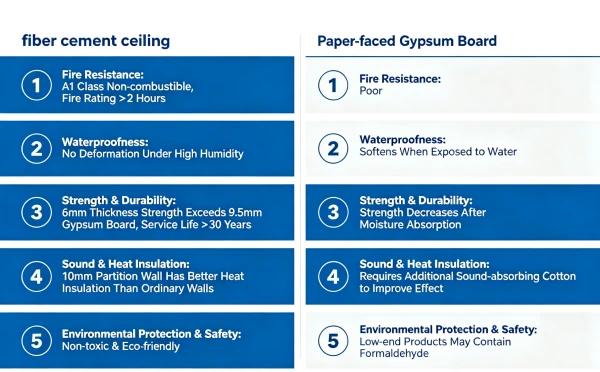
5. Environmental Protection and Safety
Calcium silicate board: Aluminum silicate fiber products are environmentally friendly and non-toxic, resistant to acid and alkali corrosion, and suitable for hospitals, schools, and other similar locations.
Regular paper-faced gypsum board: Some low-end products may contain formaldehyde; its environmental performance depends on the quality of the raw materials.