

Let's skip the corporate jargon today. Instead, I want to talk about the critical-even "life-saving"-requirements for dust extraction and safety protection in fiber cement board processing equipment.
Let's start with a plain truth: fiber cement board is a satisfying material to cut-it boasts high hardness and excellent weather resistance. However, it has a "bad temper": the dust generated during cutting is incredibly fine, much like flour. If you turn on the machinery in your workshop and it suddenly feels like a dense fog has rolled in, your dust extraction system is definitely failing the test.
Dust Extraction Requirements: Don't Let Dust "Linger" in the Workshop

First point:
Airflow must be sufficient, but-more importantly-it must be smart. Many people assume that simply installing a large fan solves everything, only to find that dust is still flying everywhere. Where does the problem lie? In the sealing. When a cutting blade spins at high speed, it generates centrifugal force that flings dust outward. Your dust collection hood must sit close to the blade-much like a kitchen range hood-capturing the dust before it has a chance to escape. We've conducted tests showing that if the suction inlet is positioned more than 10 centimeters away from the blade, the extraction efficiency drops by half.
Second point:
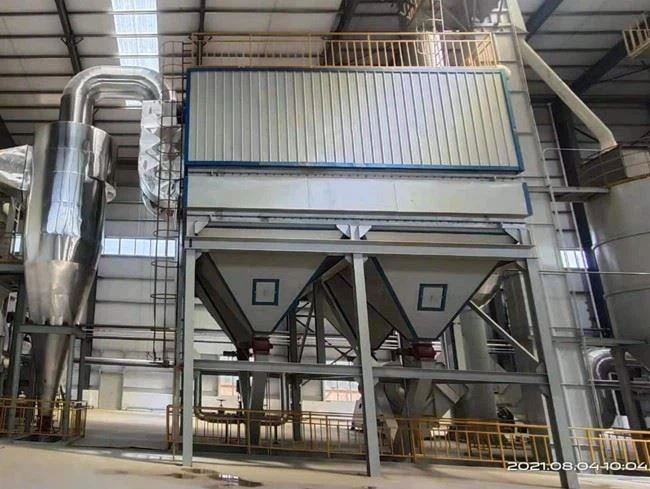
One important aspect of duct design is to make sure that it does not allow dust to build up. Because fiber cement dust has an adhesive quality, it can eventually become a hard layer that sticks to the walls of the ducts. For this reason, the best approach is to have the ductwork slightly inclined and to supply inspection windows. Every month should be sufficient to tap the ducts with a hammer and listen to the sound: if it is muffled, there is a blockage inside; if it is clear and crisp, the duct is free. This simple technique is actually better in many cases than electronic sensors.

Third point:
Filters require frequent cleaning. Don't expect a fabric baghouse dust collector to handle everything on its own. Because the dust particles are so fine, they can easily clog the filter fabric. We recommend using a pulse-jet cleaning system, which delivers a sharp "thump" every few minutes to dislodge accumulated dust from the filter bags. Otherwise-no matter how powerful your fan is-you won't generate effective suction, and the dust will ultimately escape through gaps around the cutting blade.
When it comes to safety protection, many business owners assume that simply having workers wear face masks is sufficient. It is not-far from it.
First: Give your equipment an "apron." The cutting zone must be enclosed by a dust guard-ideally a transparent one-that allows you to monitor the operation inside while effectively containing the dust. This enclosure serves a functional purpose rather than a purely aesthetic one: it is designed to prevent dust from spreading throughout the workshop. It is crucial to understand that the silica contained in cement board dust poses a significant risk to lung health if inhaled.
Second: Proper sealing of the equipment itself is essential. Moving components-such as motors, bearings, and guide rails-are particularly vulnerable to dust intrusion. We have encountered far too many instances where dust infiltrated a motor's cooling fan, abrading and severing internal windings, or worked its way into linear guide rails, effectively turning into an abrasive paste that grinds down and ruins the guide blocks. Consequently, motors must be fully enclosed units with a minimum ingress protection rating of IP55. Furthermore, guide rails should be fitted with accordion-style dust covers and cleaned thoroughly with an air gun at the end of every workday.
Lastly, give your workers the "real deal." This means equipping them not with ordinary cotton masks, but N95-level dust respirators. Besides, it is very important to inform the workers that just wearing the device without pinching the nose-clip for a tight seal will not be protective at all. If there are enough resources think of having a negative-pressure fresh-air system installed; this way, there will be an air movement from outside the workshop into it, so dust will not be able to get out of theroom.
